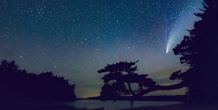
In astronomy, a conjunction occurs when two astronomical objects or spacecraft appear to be close to each other in the sky.
Click the image to zoom in (4 steps), then again for full view · the Annotated Image tab shows it annotated · open full resolutionAnnotated image · click to zoom in (4 steps), then again for full view · open full resolutionSky location chart · click to zoom in (4 steps), then again for full view · open full resolution
In astronomy, a conjunction occurs when two astronomical objects or spacecraft appear to be close to each other in the sky. This means they have either the same right ascension or the same ecliptic longitude, usually as observed from Earth.
Mercury (centre right) and the Moon at close conjunction
[Source: Wikipedia, https://en.wikipedia.org/wiki/Conjunction_(astronomy)]
Annotated Image
The annotated version is shown above - click it to zoom. Open the annotated image at full resolution.
Sky Location
The chart above shows where this image sits on the night sky. The yellow outline is its field of view, with the picture itself drawn at its true orientation; north is up and east is left. Click the chart to zoom in, and use "open full resolution" for the full-size chart.
Image Details
| Exposure: | 1/40 sec @ f/5.6 |
|---|---|
| ISO: | 100 |
| Camera: | Nikon D600 [6016 x 4016] |
| Optics: | Nikkor 80-400 mm lens at 400mm |
| Filter: | None |
| Guiding: | None |
| Controller: | None |
| Location: | Lower Sackville, Nova Scotia. |
| Date: | 2020-05-13 |
| Note: | Processed in Lightroom |